Cook What Cannot Wait

Federal food-safety guidance is consistent on this.
When the power goes out, most people think about their long-term food.


I think about the food that cannot wait.


Rice, beans, and canned food can sit. The refrigerator and the freezer are already on the clock.


That is the first food problem of a grid-down week. Not calories in the pantry. Calories that are still cold, and will not stay that way.


The clock is shorter than most people think


Federal food-safety guidance is consistent on this.


Keep the doors closed. An unopened refrigerator keeps food safe for about four hours. A full freezer holds a safe temperature for about 48 hours if the door stays shut. A half-full freezer is closer to 24 hours.


After that, the question is not “does it still look fine.” Perishable food that has been above 40°F for more than two hours should be thrown out. Meat, poultry, fish, eggs, milk, leftovers, and opened deli items are in that group. Do not taste food to decide. Appearance and smell are not enough.


Some things in the refrigerator last longer: hard cheese, butter, mustard, ketchup, jelly, uncut fruit and vegetables, and bread. Those are not the problem. The problem is the chicken, the milk, and last night’s leftovers.


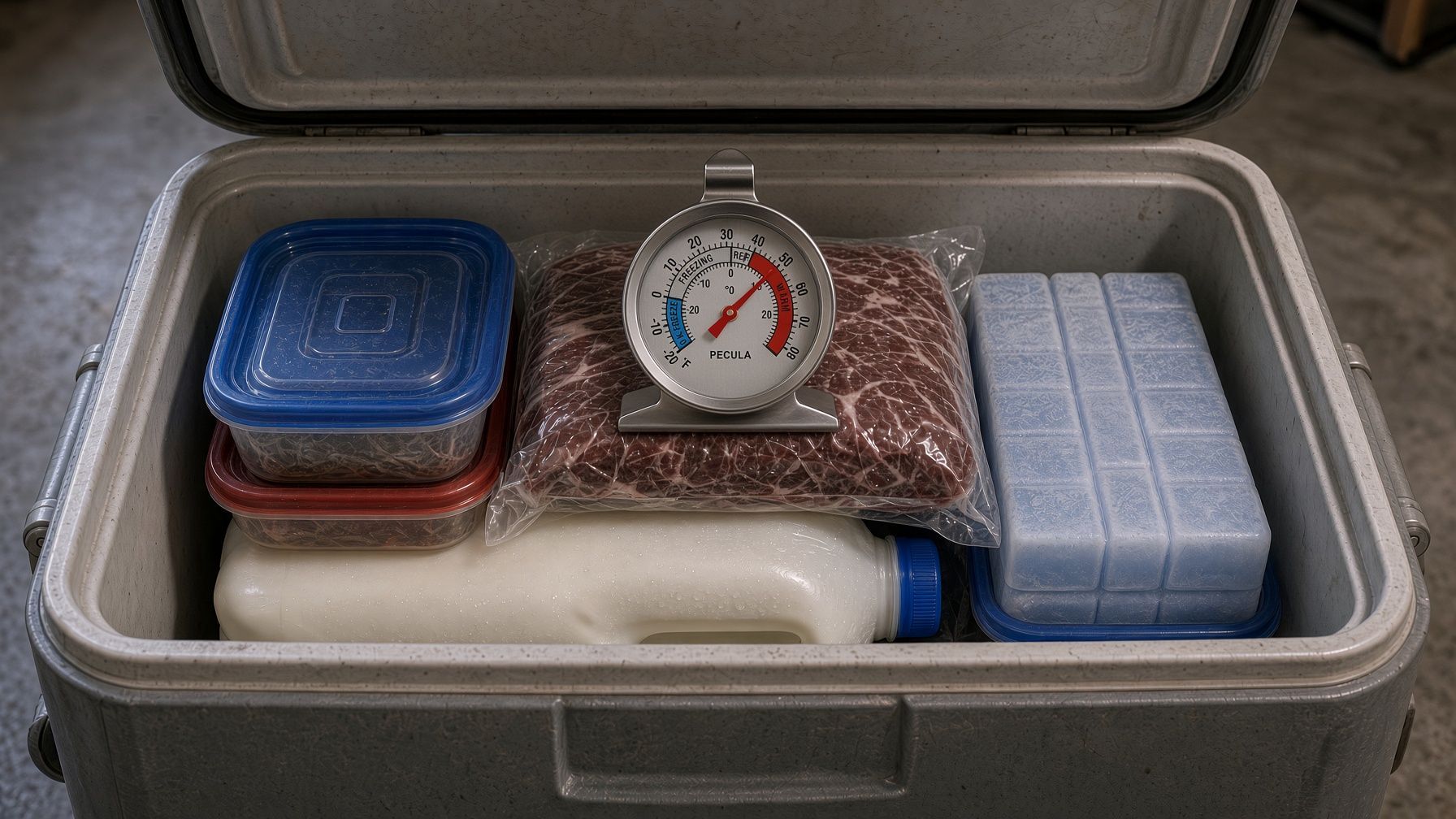
A thermometer tells you more than a guess. Put one in the refrigerator and one in the freezer before you need them. Put another in any cooler you load. The number you want is 40°F or below for food you still plan to eat cold, and ice crystals — or 40°F or below — for frozen food you plan to refreeze or cook.


What I actually do here


I keep a deep freezer in the garage on solar. That freezer is not only food storage. It is also the cold I will need if the house refrigerator dies.


A few freezer blocks live in that freezer all the time. They stay frozen because the freezer stays frozen. When the power goes out and the kitchen refrigerator is the weak link, those blocks go into coolers with the food that cannot wait. The deep freezer keeps doing its job. The coolers buy time for the milk, the leftovers, and the meat that was sitting on the refrigerator shelves.


That method matches what the USDA and CDC already tell people to do: freeze gel packs or containers of water ahead of time, keep coolers ready, and move refrigerated perishables into a cooler with a cold source if the power will be out more than four hours. The point of keeping the blocks in a working freezer is that they are already frozen when you need them. You do not have to find ice after the stores go dark.


If solar is still running the freezer, leave the frozen food in the freezer. Do not empty it into coolers for the sake of doing something. Pull the blocks. Pull only what you plan to cook soon. Every time you open a freezer that is holding, you spend cold you may need later.


How to use a cooler so the four-hour clock actually stops


A cooler does not make food safe by existing. It only works if the food stays at 40°F or below.


Pack it tight. Cold air leaks around empty space. Put the freezer blocks or frozen water jugs in with the food, and keep raw meat in its own bag so it cannot drip on anything else. Cold sinks, so putting the frozen mass high in the cooler helps the rest of the load. Keep the lid shut. Keep the cooler in the shade, indoors if you can.


There is no honest single number for “how many hours a cooler lasts.” A cheap cooler in a warm garage, opened every twenty minutes, will not match a thick cooler in a cool room that nobody opens. That is why the thermometer goes in the cooler. If the food climbs above 40°F and stays there, the cooler has failed. Cook what is still safe, or throw out what sat warm too long.


Frozen jugs of water do two jobs. They hold the cold, and as they melt they become drinking water. Gel packs do not.


If you can get block ice or dry ice later, that stretches a freezer that is no longer running. Fifty pounds of dry ice will hold an 18-cubic-foot full freezer about two days. Do not handle dry ice with bare hands, and do not set it directly on food.


Do not use the porch as a refrigerator. Outdoor temperature swings, animals, and contamination make that a bad plan even when the air feels cold.


What to cook first


Cook the food that will spoil, not the food that stores well.


Start with leftovers, milk you will not drink cold, opened packages, and raw meat that will not fit in the cooler. That is supper. Dry beans can wait. They need water, time, and fuel. The refrigerator does not care that you have a fifty-pound bag of rice in the pantry.


Use the heat you already have. If that is a propane burner, a wood stove, or a fire you can tend, cook a meal that uses the perishable food and does not run for hours. A pan of leftover meat and vegetables is a better first meal than a pot of dry beans that ties up fuel while the chicken warms on the counter.


If the freezer is still holding, leave it closed and eat from the refrigerator and the coolers first. If the freezer is the one failing, cook what you can while it is still cold enough to be safe. Food that still has ice crystals, or that is still at 40°F or below, can be cooked or refrozen. Quality may drop. Safety is the line.


Group what you will cook so you open the refrigerator or cooler once. Standing in the open door to think is how you spend the four hours.


Do this while the power is still on


Keep appliance thermometers in the refrigerator and the freezer.


Keep two or three coolers you can reach in the dark.


Keep freezer blocks or filled water jugs in the freezer so they are already frozen.


Know which shelf in the refrigerator is the perishable shelf — milk, meat, leftovers — so you can pull it without a scavenger hunt.


Decide now what stays powered if you have a battery or solar station.


On this place the solar keeps the refrigerator and the deep freezer alive, and charges lamps and radios.


The generator only runs long enough to top the batteries when the sun is not enough. That is a different problem than a dark kitchen with a warming fridge. If you do not have that setup, the four-hour clock is the plan.


A bag of beans is a lot of calories. It is not tonight’s meal. Tonight’s meal is whatever will go bad if you ignore it.


What would you cook first?


Official times in the piece:

  • fridge about 4 hours unopened;
  • full freezer about 48 hours; half-full about 24;
  • perishable food above 40°F for more than 2 hours gets discarded;
  • dry ice figure is USDA’s 50 pounds / 18 cubic feet / 2 days.


A cooler with freezer blocks has no honest fixed hour count — only “stays at 40°F or below,” which is why the thermometer is in there.


Never miss an article. Subscribe FREE to get notified when a new article is published!

Preparedness is only the beginning. The Ridge Plan explores what happens when stored supplies are no longer enough—and ordinary neighbors must turn preparation into decisions, trust, and survival.

Mountain House Beef Potato Hash
By R.T. Fagan • September 6, 2026
Serves 2 · ≈1,000 cal each Ingredients 2 servings Mountain House diced beef, rehydrated 3 cups rehydrated Augason Farms potato shreds or slices 4 Tbsp vegetable oil or olive oil ½ cup rehydrated Augason Farms spinach flakes ½ cup rehydrated diced carrots 5 garlic cloves, minced Smoked paprika, cumin, salt, black pepper Method Heat oil in a cast-iron skillet over the coals. Add potatoes in a single layer. Let them crisp before stirring. Add garlic, beef, carrots, and spices. Cook 5–6 minutes. Fold in spinach at the end so it wilts into the hash. Nutrition (full meal / per person) Calories: ≈2,010 / 1,005 Protein: ≈66 g / 33 g Carbs: ≈160 g / 80 g Fiber: ≈14 g / 7 g Significant vitamins/minerals: Protein, iron and zinc (beef), potassium (potatoes), vitamin A and C (carrots/spinach), calorie-dense oil More recipes and additional bonus material can be found at https://www.griddownfiction.com/bonus-material
Fire-Pot Ramen with Chicken, Egg & Broccoli
By R.T. Fagan • September 5, 2026
Serves 2 · ≈1,000 cal each Ingredients 6 bricks Top Ramen (seasoning packets optional / use sparingly) 2 cans canned chicken, drained 2 servings powdered eggs, rehydrated and scrambled 4 Tbsp vegetable oil 1 cup rehydrated Augason Farms broccoli florets 4 garlic cloves, minced Broth if available, chili flakes, black pepper, optional soy sauce Method Cook ramen in a pot over the fire until just tender. Drain most of the water, leave a little. In a skillet, heat oil. Sauté garlic, then scramble the powdered eggs and set aside. Add chicken and broccoli to the oil. Heat through. Combine noodles, eggs, chicken, and broccoli. Toss with remaining oil. Season. Nutrition (full meal / per person) Calories: ≈2,030 / 1,015 Protein: ≈68 g / 34 g Carbs: ≈195 g / 98 g Fiber: ≈10 g / 5 g Significant vitamins/minerals: Protein from chicken and eggs, vitamin C and K (broccoli), B-vitamins (noodles), fats from oil for calorie density More recipes and additional bonus material can be found at Https://www.griddownfiction.com/bonus-material
Creamed Corn Chicken & Rice Skillet
By R.T. Fagan • September 4, 2026
Serves 2 · ≈1,000 cal each Ingredients 2 cans canned chicken, drained 3 cups cooked brown or white rice 1 can cream corn 4 Tbsp extra-virgin olive oil or vegetable oil ½ cup rehydrated Augason Farms broccoli florets 4 garlic cloves, minced Salt, black pepper, paprika, dried thyme Method Heat oil in a large skillet over the fire. Sauté garlic 30 seconds. Add chicken and broccoli. Cook 2 minutes. Stir in cream corn and rice. Simmer until thick, creamy, and hot. Adjust seasoning. Nutrition (full meal / per person) Calories: ≈2,000 / 1,000 Protein: ≈70 g / 35 g Carbs: ≈180 g / 90 g Fiber: ≈12 g / 6 g Significant vitamins/minerals: High protein and niacin (chicken), vitamin C (broccoli), B-vitamins (rice), vitamin A (corn), calorie-dense oil 
Black Bean Burger Skillet with Corn & Potatoes
By R.T. Fagan • September 3, 2026
Serves 2 · ≈1,000 cal each Ingredients 2 servings Augason Farms black bean burger (prepared per package) 2 cups cooked or rehydrated Augason Farms potato slices or shreds 1 cup kernel corn or cream corn 4 Tbsp extra-virgin olive oil or vegetable oil ¼ cup Augason Farms cheese blend powder ½ cup rehydrated spinach flakes (optional) 4 garlic cloves, cumin, smoked paprika, chili powder, salt Method Heat oil in a cast-iron skillet over medium coals. Brown the black bean burger mix, breaking it into crumbles. Add garlic, spices, potatoes, and corn. Cook 6–8 minutes, stirring so the potatoes crisp on the edges. Sprinkle cheese powder and fold in spinach. Heat until the cheese melts into the skillet. Nutrition (full meal / per person) Calories: ≈2,000 / 1,000 Protein: ≈58 g / 29 g Carbs: ≈200 g / 100 g Fiber: ≈28 g / 14 g Significant vitamins/minerals: High fiber and folate (black beans), potassium (potatoes), vitamin A (corn/spinach), calcium (cheese powder), healthy fats from oil More recipes and additional bonus material can be found at https://www.griddownfiction.com/bonus-material
Baked Bean, Green Bean & Chicken Garlic Skillet
By R.T. Fagan • September 1, 2026
Serves 2 · ≈1,000 cal each Ingredients 2 cans baked beans 1–2 cans canned chicken, drained 1 can cut green beans, drained 4 Tbsp extra-virgin olive oil 5 garlic cloves, minced 1 cup cooked rice (optional stretcher if you want extra bulk) Smoked paprika, black pepper, chili flakes, salt Method Heat olive oil in a deep skillet or Dutch oven over the fire. Sauté garlic 30 seconds. Add chicken and green beans. Heat 2 minutes. Stir in baked beans. Simmer until thick and bubbling. Fold in rice if using. Taste and add heat.  Nutrition (full meal / per person) Calories: ≈2,000 / 1,000 Protein: ≈72 g / 36 g Carbs: ≈175 g / 88 g Fiber: ≈24 g / 12 g Significant vitamins/minerals: High fiber (baked beans), protein (chicken + beans), vitamin K and C (green beans), lycopene if sauce is tomato-based, healthy fats from olive oil More recipes and additional bonus material can be found at https://www.griddownfiction.com/bonus-material
minced Clam Garlic Tomato Pasta
By R.T. Fagan • September 1, 2026
Serves 2 · ≈1,000 cal each Ingredients 12 oz dry pasta 2 cans minced clams, drained (reserve a little liquid) 1½ cups tomato sauce or tomato chunks & garlic 5 Tbsp extra-virgin olive oil 1 cup rehydrated Augason Farms spinach flakes or broccoli 6 garlic cloves, minced Salt, black pepper, red pepper flakes, dried oregano Method Boil pasta in salted water over the fire. Drain, save ½ cup pasta water. In a skillet, heat olive oil. Sauté garlic 30 seconds. Add tomato sauce, clams, reserved clam liquid, and greens. Simmer 3–4 minutes. Toss in pasta and a splash of pasta water until glossy. Season well. Nutrition (full meal / per person) Calories: ≈2,010 / 1,005 Protein: ≈64 g / 32 g Carbs: ≈185 g / 92 g Fiber: ≈16 g / 8 g Significant vitamins/minerals: Iron, B12 and selenium (clams), lycopene and vitamin A (tomato), vitamin K/C (greens), monounsaturated fats and vitamin E (olive oil) More recipes and additional bonus material can be found at https://www.griddownfiction.com/bonus-material
Pulled Pork Pineapple Fried Rice
By R.T. Fagan • September 1, 2026
Serves 2 · ≈1,000 cal each Ingredients 2 cans pulled pork, drained 4 cups cooked jasmine or long-grain rice (day-old best) 1 can pineapple chunks, drained (reserve 2 Tbsp juice) 5 Tbsp coconut oil or vegetable oil 1 cup rehydrated Augason Farms diced carrots or veg medley 6 garlic cloves, minced Salt, black pepper, chili flakes, optional soy sauce Method Heat 3 Tbsp oil in a wok or cast-iron skillet over the open fire. Add garlic and flash-fry 20 seconds. Add rice and break up clumps. Fry 3–4 minutes until it picks up color. Stir in pulled pork, pineapple, reserved juice, and vegetables. Add remaining oil. Cook until hot and slightly caramelized. Season hard. Nutrition (full meal / per person) Calories: ≈2,020 / 1,010 Protein: ≈62 g / 31 g Carbs: ≈190 g / 95 g Fiber: ≈12 g / 6 g Significant vitamins/minerals: Vitamin C (pineapple/carrots), B-vitamins and iron (pork + rice), vitamin A (carrots), calorie-dense fats from oil More recipes and additional bonus material can be found at https://www.griddownfiction.com/bonus-material
Black cast-iron pot of bubbling stew over an open flame with a golden crust on top
By R.T. Fagan • August 21, 2026
Serves 2 · ≈1,000 cal each Ingredients 2 cans chili con carne with beans 1 box or package corn bread mix (prepared with water + 2 Tbsp vegetable or olive oil) 3 Tbsp extra-virgin olive oil 1 cup rehydrated kernel corn 4 garlic cloves, extra chili powder, cumin, salt Method Heat olive oil in a Dutch oven or deep cast-iron skillet over the open fire. Sauté garlic. Add chili + corn; simmer 5 minutes. Prepare cornbread batter (add oil for richness). Pour batter over the chili. Cover tightly and cook over low coals or with coals on the lid until the cornbread is set and golden.  Nutrition (full meal / per person) Calories: ≈2,020 / 1,010 Protein: ≈55 g / 27 g Carbs: ≈230 g / 115 g Fiber: ≈25 g / 12 g Significant vitamins/minerals: High fiber & protein (chili/beans), vitamin A & lycopene, healthy fats (olive + vegetable oil), iron
A pot of bubbling fruit dessert cooking over an open campfire, with steam rising and flames below.
By R.T. Fagan • August 21, 2026
Serves 2 · ≈1,000 cal each Ingredients 3 cups dry oatmeal 4 Tbsp peanut butter 3 Tbsp coconut oil ½ cup raisins + ½ cup rehydrated Augason Farms mixed fruit / blueberries / sliced apples 2 Tbsp honey or maple syrup Pinch salt, cinnamon, optional powdered milk for creaminess Method Cook oatmeal in water (or reconstituted milk) in a pot over the open fire until thick. Stir in coconut oil and peanut butter until melted and creamy. Fold in fruit and raisins. Sweeten and spice. Serve hot from the fire.  Nutrition (full meal / per person) Calories: ≈2,000 / 1,000 Protein: ≈50 g / 25 g Carbs: ≈220 g / 110 g Fiber: ≈28 g / 14 g Significant vitamins/minerals: High healthy fats & vitamin E (peanut butter + coconut), potassium & antioxidants (fruit/raisins), sustained energy from complex carbs + soluble fiber
Black cast-iron pot simmering over flames, filled with dark stew and chunks of vegetables.
By R.T. Fagan • August 21, 2026
Serves 2 · ≈1,000 cal each Ingredients 1 cup dry Clear Creek red lentils 1 can (or 2 cups) black beans 1–2 servings Mountain House diced beef (rehydrated) 4 Tbsp coconut oil 1 cup rehydrated Augason Farms potato shreds or slices ½ cup rehydrated spinach or veg medley 5 garlic cloves, cumin, smoked paprika, bay leaf, salt, chili Method Simmer lentils in water/broth over the fire until soft (15–20 min). In the same pot melt coconut oil; add garlic + spices. Stir in beef, black beans, potatoes, and greens. Simmer 5 more minutes until thick and bubbling over the flames.  Nutrition (full meal / per person) Calories: ≈2,010 / 1,005 Protein: ≈78 g / 39 g Carbs: ≈175 g / 87 g Fiber: ≈35 g / 17 g Significant vitamins/minerals: Extremely high fiber & iron (lentils + beans), vitamin A & C (greens), MCTs (coconut oil), zinc & B-vitamins