Grid-Down Power That Actually Lasts: Solar, Batteries, and a Generator Used the Right Way
Have a licensed electrician design and install anything that ties into your breaker panel, generator inlet, interlock, transfer switch, hybrid inverter, or battery system. Pull the required permits and get the work inspected. Improvised panel wiring and backfeed can start fires and can kill utility workers. This article is planning guidance, not a wiring manual.
When the grid goes down, the goal is not to keep the whole house comfortable. The goal is cold food, water, communications, and one room you can live in.
Heat and cool that room. Leave the rest of the house dark.
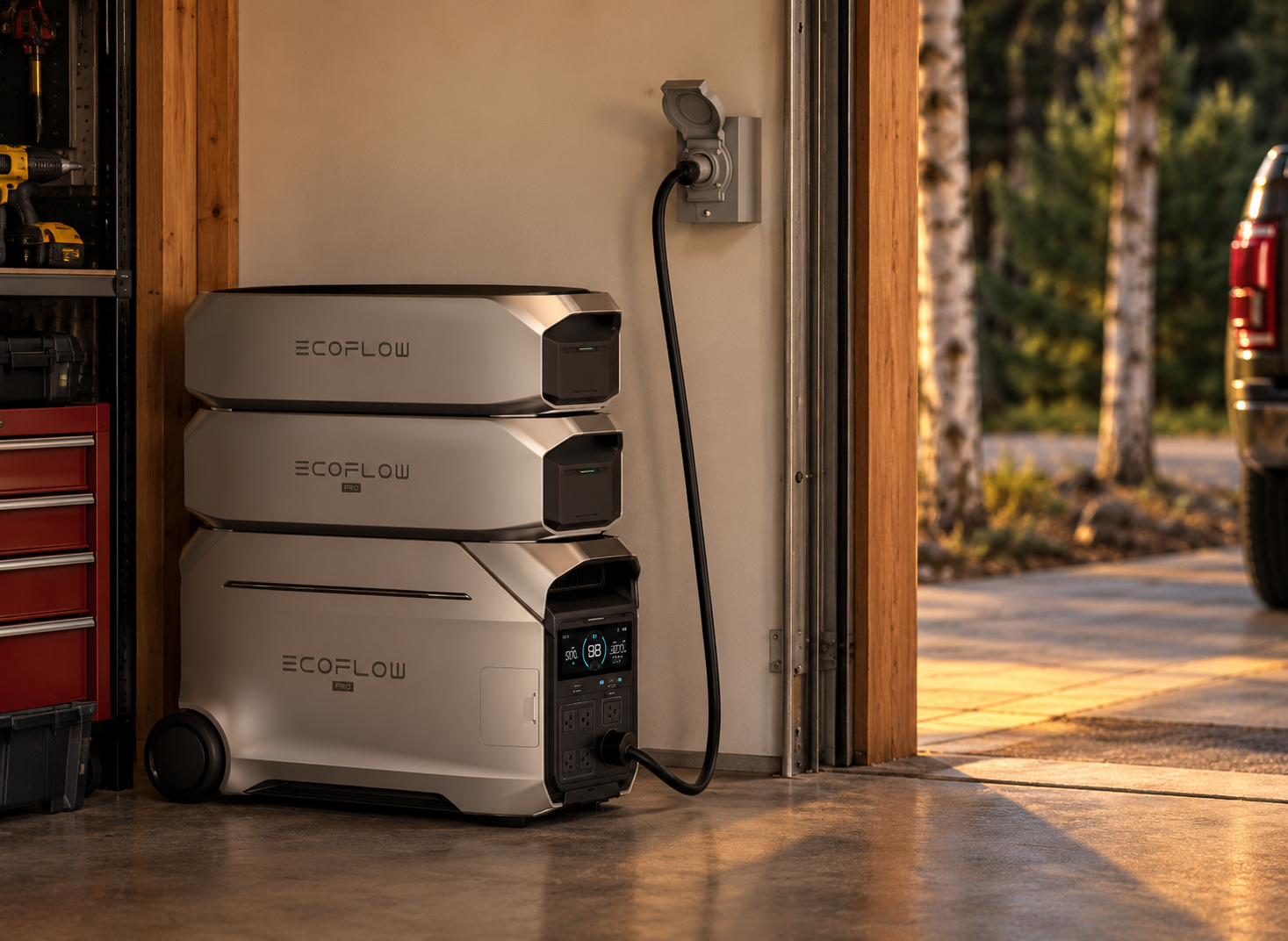
The most fuel-efficient way to do that is not to run the house on a generator. It is to run critical loads from batteries, let solar recharge those batteries whenever the sun is out, and use the generator only to recharge the bank when it gets low.
The setup
A practical layout looks like this:
- A listed 50 amp, 240 volt inlet wired to a transfer path on the breaker panel (or to a hybrid inverter with a generator input).
- You can connect either the battery inverter or the generator—never both at once unless the equipment is designed for that.
- The panel, or better a critical-loads subpanel, draws only what you leave on.
- Solar charges the batteries first.
- When the batteries get low, the generator recharges the batteries. Then it shuts off.
The house lives on the battery.
The generator is a battery charger, not a 24-hour house engine. A generator loafing all day at a light load wastes fuel, wears poorly, and still leaves you noisy and exposed. A few hours at a healthy load, then silence, is the efficient pattern.
There are many equipment options. Selection depends on budget, climate, and which circuits you are willing to turn off. The operating order does not change: solar first, battery next, generator last.
What gets power
Do not back up the whole house.
Keep on (Tier 1)
- Refrigerator and freezer
- Communications: modem, router, phones
- Medical equipment if you have it
- A few LED lights in the live room and a path to it
- Water in short cycles (well or booster), or stored water if the pump is too large
- The inverter and battery system itself
Only if the battery is in good shape (Tier 2)
- Laptop
- A small fan
- Short cooking on a microwave or induction burner
- Sump pump if flooding is a real risk
Leave off (Tier 3)
- Central heat and air
- Electric range and oven as a habit
- Dryer, dishwasher, and electric water heater
- Whole-house lighting
- Shop tools and EV charging
- The extra fridge in the garage
A modern refrigerator is often around 1 kWh per day. A handful of LED bulbs and a router add a fraction of that. Central HVAC can use more in one afternoon than the critical loads use in a full day. That is how small systems die overnight.
Write the “leave on” list on the panel door. Flip everything else off and leave it off.
Live in one room
Pick the room that is easiest to hold. In winter, an interior room with fewer exterior walls. In summer, a shaded room you can cross-ventilate. Keep it close to the kitchen so the refrigerator is not a separate trip.
Close doors. Hang a blanket over the opening if you need to. You are creating a small livable zone, not conditioning 1,800 square feet.
Winter
Heat that room only. Use a wood stove if you have one, or an indoor-rated propane or kerosene heater with working carbon monoxide alarms. An electric space heater is a last resort: 500 watts for eight hours is 4 kWh, more than the fridge, lights, and internet combined. If you use electric heat at all, use a small oil-filled radiator only while you are awake and the battery is well above empty. Sleep in layers. Protect pipes by dripping a faucet or draining lines rather than running heat tape on a dying bank.
Summer
Same closed-off room. Use a box fan first. If you must use air conditioning, use a small window unit in that room only, and only during the hottest hours. Cook outside. Keep the refrigerator door shut.
A budget you can actually support
For one room, a fridge, communications, and occasional pumping, plan on 3 to 8 kWh per day. Stay closer to 3 to 5 kWh if you skip mechanical cooling.
LoadTypical daily energy
- Refrigerator0.8–1.5 kWh
- Lights, phones, router0.3–0.6 kWh
- Laptop or radio0.2–0.5 kWh
- Well or sump, short cycles0.3–1.5 kWh
- Room fan or brief window AC0.5–3 kWh
Working total: 3–8 kWh/day
From that number:
- Battery: about 10–15 kWh of LiFePO4 covers roughly two days of critical loads. Lithium is worth it here: you can use most of the nameplate capacity, it charges faster from a generator, and less energy is lost as heat than with lead-acid.
- Solar: 2–6 kW will refill a 3–8 kWh day on decent sun. Size toward your worst season, not July.
- Generator: 3–7 kW is enough if it is charging batteries for two to four hours, not running the HVAC. A 50 amp, 240 volt inlet is then a convenient hookup, not a promise that the whole house stays on.
Do not try to cover a two-week ice storm with batteries alone. Cover ordinary outages with solar and storage. Cover the long, dark tail with fuel and load discipline.H the power should be divided
Best: a critical-loads subpanel that contains only Tier 1 circuits, and maybe one Tier 2 circuit. The inverter or inlet feeds that subpanel. The main panel stays off unless you deliberately turn something on.
Acceptable: the same 50 amp inlet and a panel interlock, with you turning off HVAC, water heater, range, dryer, and spare lighting by hand every outage.
Do not energize an entire 200 amp panel from a modest battery and hope nobody turns on the air conditioner.
Match the inlet, cord, and generator connector. A 50 amp inlet is not 12,000 watts if the generator cannot make 12,000 watts. The engine is the limit.
Neutral bonding and GFCI behavior have to be correct for your specific generator and inverter. That is one of the reasons this is licensed work.
How to run an outage
- Isolate from the utility with the interlock, transfer switch, or hybrid island mode.
- Shed load. HVAC off. Water heater off. Extra lights off.
- Close the house down to the live room.
- Confirm the refrigerator is on a backed-up circuit.
- Watch battery state of charge. Start the generator around 25–30%, charge hard, shut it down. Do not trickle-charge all night at a light load.
- Use every clear hour of sun. Save laundry and heavier cooking for those days.
- If weather stays bad and the bank is falling, drop Tier 2. Refrigerator and communications last.
Test the path before storm season: transfer, start the well or fridge compressor, confirm nothing is backfeeding the meter.
Equipment follows the plan, not the other way around
A staged system can be an inlet, interlock or manual transfer switch, a modest inverter, 10–15 kWh of lithium, a small solar array, and a dual-fuel portable used only to recharge.
A more integrated system is a hybrid inverter with a generator input, the same critical-loads discipline, and auto-start if you want less babysitting.
Brands and exact kilowatt-hours change with budget and climate. What does not change is this: the panel only draws what you leave on, solar fills the batteries when it can, and the generator is for recharging—not for living like the grid is still up.
The point
On land, grid-down power is a rationing problem. You need cold food, some form of water, a way to call out, and one room you can sleep in without turning the outage into a medical problem. Whole-house heat and cooling is a grid luxury. In a bad week it is the fastest way to empty the bank and burn fuel for no extra safety.
Plan the loads first. Size the battery and solar to those loads. Keep the generator in reserve as a charger. And have a licensed electrician permit and install the connection to your panel.
Preparedness is only the beginning. The Ridge Plan explores what happens when stored supplies are no longer enough—and ordinary neighbors must turn preparation into decisions, trust, and survival.


