The 30-Day Preparedness Goal Guide

From 72 Hours to 30 Days:
How to Build a Realistic One-Month Preparedness Plan
If you have prepared for 72 hours, you've taken an important first step.
You have enough supplies to get through the initial disruption—the period when stores may close, roads may be blocked, power may be out, and emergency services may be overwhelmed.
But there is a big difference between being prepared for three days and being prepared for thirty.
A 72-hour kit is designed to help you survive the immediate crisis.
A 30-day plan is designed to help your household function when the crisis lasts longer than expected.
That distinction matters.
A winter storm, earthquake, wildfire, extended power outage, cyberattack, infrastructure failure, or other disaster doesn't necessarily end after three days. In some situations, the first 72 hours may be only the beginning.
The good news is that moving from 72 hours to 30 days doesn't mean buying four times as much stuff.
It means changing the way you think about preparedness.
Instead of asking:
"What do I need to survive for three days?"
start asking:
"What does my household need to keep functioning for the next 30 days if normal services aren't available?"
Here's how to make that transition.
First: Understand What Changes After 72 Hours
During the first three days, your priorities are relatively simple:
- Water
- Food
- Shelter
- First aid
- Light
- Communications
- Basic sanitation
At 30 days, those same priorities remain—but they become systems.
You now have to consider:
- How will you obtain and treat water?
- How will you prepare food?
- How will you dispose of human waste?
- How will you maintain personal hygiene?
- How will you keep medications available?
- How will you recharge batteries?
- How will you stay informed?
- How will you handle trash?
- What happens if something breaks?
- How will you replace something you forgot?
- What happens if someone gets sick?
- What happens if you have to leave?
That is the difference between a kit and a plan.
The American Red Cross currently recommends keeping at least two weeks of food and water at home and, if possible, a one-month supply of medications.
Thirty days takes that concept one step further.
Priority #1: Water
If you're going to extend your preparedness from 72 hours to 30 days, start here.
Not food.
Not ammunition.
Not solar panels.
Water.
Federal preparedness guidance uses a baseline of one gallon of water per person per day, while recognizing that actual requirements vary with climate, activity, age, health, and other circumstances. (FEMA)
For a couple:
1 gallon × 2 people × 30 days = 60 gallons
That's your baseline emergency water requirement.
And remember that one gallon per person per day is a planning baseline—not necessarily everything you'll need for drinking, cooking, hygiene, and other household uses.
Your 30-day water target
For two adults:
- 60 gallons minimum baseline
- Additional water for pets
- Additional water for sanitation and hygiene
- Additional water for medical needs
- Additional water for hot weather or strenuous activity
You don't necessarily have to store all 60 gallons as drinking water in individual containers.
A better approach is to build layers.
Layer 1: Immediate drinking water
Keep readily accessible bottled or containerized water for the first several days.
Layer 2: Bulk stored water
Use properly rated, food-grade water containers for longer-term storage.
Layer 3: Water treatment
Have a way to make additional water safe if your stored supply becomes inadequate.
That means having a combination of:
- A quality water filter
- A chemical disinfectant appropriate for emergency water treatment
- A way to boil water
- Clean containers for collecting and storing treated water
Don't wait until you need to purify water to learn how your equipment works.
Test it now.
The goal isn't necessarily to store 30 days of water.
The goal is to have 30 days of reliable access to safe water.
For some households, that means extensive storage.
For others, it means a combination of stored water, a reliable source, filtration, treatment, and the ability to transport water.
Priority #2: Food
Once water is addressed, food becomes your next major concern.
And this is where many preparedness plans go wrong.
People buy a large quantity of emergency food and assume they're finished.
They're not.
A 30-day food supply needs to be:
nutritious, familiar, reasonably balanced, storable, and practical to prepare.
Start by calculating what your household actually eats.
For each person, estimate:
- Calories
- Protein
- Carbohydrates
- Fat
- Special dietary requirements
You don't need laboratory precision.
You need a reasonable baseline.
Then build your supply around foods you already eat.
For a couple
Build a 30-day food supply for 60 person-days.
For example:
2 people × 30 days = 60 person-days
If you have four people:
4 × 30 = 120 person-days
Six people:
6 × 30 = 180 person-days
This makes scaling your food supply straightforward.
Don't Build a "Survival Food" Pantry
Build a working pantry.
A good 30-day supply might include combinations of:
Proteins
Canned chicken
Canned tuna
Canned salmon
Peanut butter
Beans
Lentils
Shelf-stable meats
Freeze-dried meat
Eggs or powdered eggs
Nuts
Carbohydrates
Rice
Pasta
Oats
Potatoes
Flour
Tortillas
Crackers
Quinoa
Other shelf-stable grains
Fruits and vegetables
Canned vegetables
Canned fruit
Applesauce
Freeze-dried vegetables
Freeze-dried fruit
Dehydrated foods
Fats
Don't overlook these.
Cooking oil, peanut butter, nuts and other shelf-stable fats provide valuable calories in a relatively small amount of storage space.
Flavor
This sounds trivial until you're eating the same basic foods day after day.
Stock:
Salt
Pepper
Spices
Bouillon
Hot sauce
Soy sauce
Sugar or honey
Drink mixes
Coffee or tea
Seasoning isn't a luxury.
It's one of the cheapest ways to make a repetitive emergency diet considerably more tolerable.
Build Meals, Not Just Ingredients
This is one of the most important upgrades from 72 hours to 30 days.
Don't simply count cans.
Create actual meals.
For example:
Breakfast
Oatmeal + powdered milk + fruit + nuts
Lunch
Rice + beans + canned vegetables + seasoning
Dinner
Pasta + canned meat + tomato sauce + vegetables
Alternative dinner
Potatoes + canned meat + vegetables + gravy
Then calculate how many times you can make each meal.
If you have 30 days of ingredients but no idea what you're going to eat, you don't have a food plan.
You have an inventory.
Eat Your Stored Food Before You Need It
One of the best preparedness systems is simple:
Store what you already eat, then eat what you store.
Rotate your pantry.
Use the oldest products first.
Replace them when you shop.
This prevents your emergency supply from becoming a forgotten collection of expired cans.
It also answers an important question:
Will my family actually eat this?
You'll discover the answer before the emergency—not during it.
Priority #3: Cooking
Food doesn't help much if you can't prepare it.
A 72-hour kit may get by with ready-to-eat food.
Thirty days is different.
You need a cooking system.
Have at least one method that doesn't depend on the electrical grid.
Depending on your circumstances, that could include:
Propane camp stove
Propane grill
Outdoor cooking system
Wood-burning stove
Rocket stove
Other appropriate alternative cooking method
And don't forget:
fuel.
Know how much fuel your cooking system actually consumes.
Test it.
Then calculate how much you'll need for 30 days.
Never use outdoor combustion appliances inside a home, garage, tent, or other enclosed space because of carbon-monoxide risk.
Priority #4: Medications and Medical Supplies
A 30-day emergency exposes weaknesses that a three-day emergency may not.
Review every medication and medical supply your household uses.
Create a list showing:
- Medication name
- Dosage
- Frequency
- Prescribing provider
- Pharmacy
- Refill information
The Red Cross recommends having a one-month supply of medications when possible. (American Red Cross)
Also consider:
- Prescription medications
- Over-the-counter pain relievers
- Allergy medications
- Antacids
- Anti-diarrheal medication
- Thermometer
- Bandages
- Gauze
- Antiseptic supplies
- Medical tape
- Disposable gloves
- Prescription glasses
- Contact-lens supplies
- Medical equipment batteries
Don't stock random medications simply because someone on the internet said they're useful.
Build around the actual medical needs of your household.
Priority #5: Sanitation
This is one of the biggest differences between a 72-hour emergency and a 30-day emergency.
You can tolerate an improvised sanitation solution for a short period.
Thirty days is another matter.
Think about:
Toilet
What happens if your water supply stops and the toilet can no longer be flushed?
Have a safe contingency plan.
Trash
Thirty days creates a surprising amount of garbage.
Have heavy-duty garbage bags and a way to contain waste.
Personal hygiene
Stock:
Toilet paper
Soap
Hand sanitizer
Toothpaste
Toothbrushes
Shampoo
Feminine hygiene products
Disposable wipes
Paper towels
Cleaning supplies
Laundry supplies
And remember:
Water used for drinking isn't the only water you'll need.
Hygiene, cleaning and sanitation can consume significant quantities.
Priority #6: Light and Power
At 72 hours, a flashlight is essential.
At 30 days, you need an energy strategy.
Start with the basics:
- LED flashlights
- Headlamps
- Lanterns
- Spare batteries
Then move to rechargeable systems:
- Power banks
- Rechargeable batteries
- Battery chargers
- USB charging capability
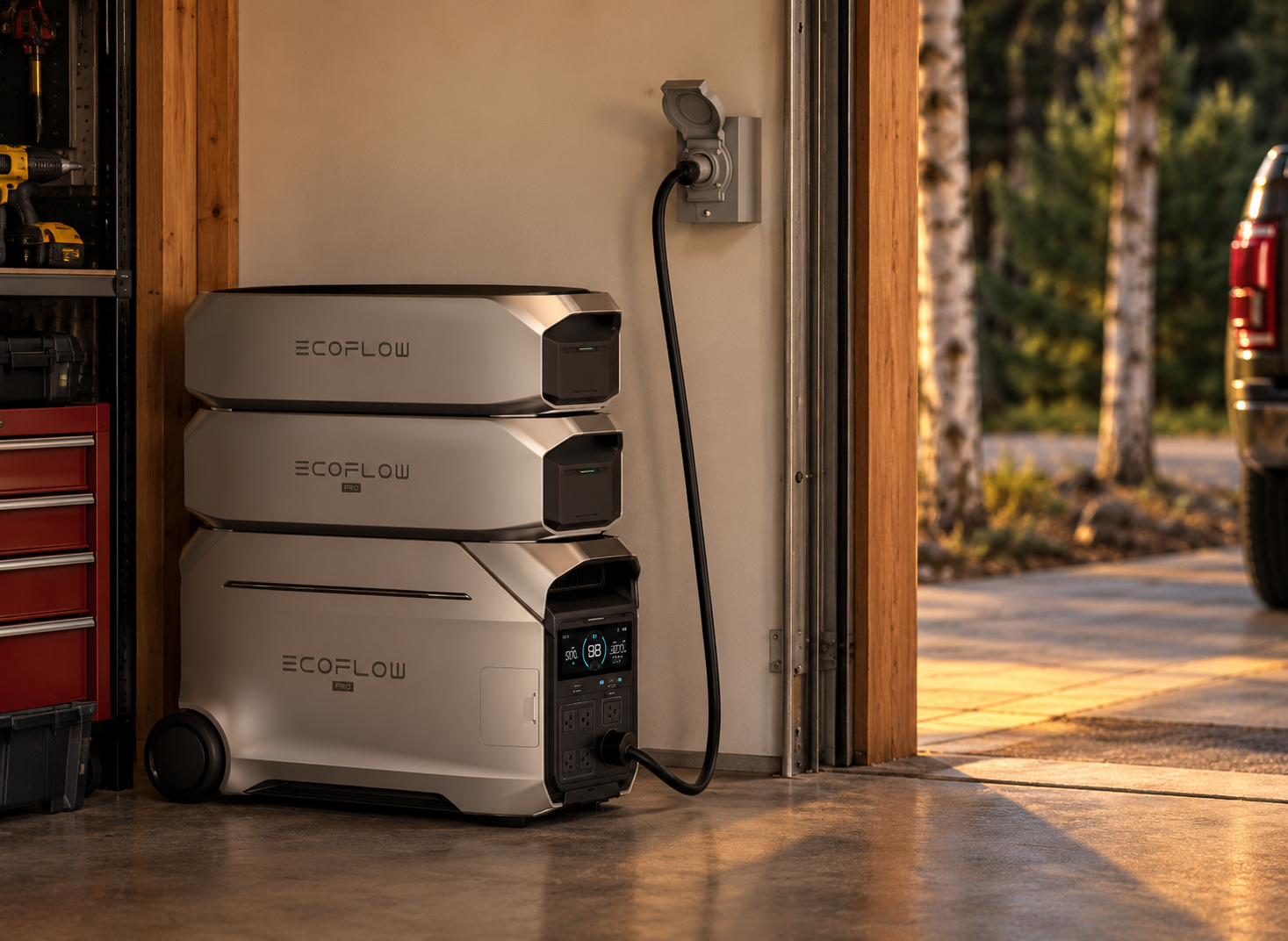
Then consider larger backup power:
- Portable power stations
- Solar panels
- Generator
- Vehicle charging
But don't make the mistake of assuming that having a generator means you're prepared.
Ask:
What am I going to power?
Make a priority list.
Tier 1 — Critical
- Medical equipment
- Communications
- Necessary refrigeration
- Essential lighting
Tier 2 — Important
- Internet access
- Phones
- Computers
- Freezers
- Small appliances
Tier 3 — Comfort
- Television
- Entertainment
- Nonessential appliances
Know the wattage of your critical equipment.
Know how much fuel or battery capacity you have.
Then test the system under realistic conditions.
Priority #7: Communications
When the power goes out, communications can become more important—not less.
Have multiple ways to receive information.
Consider:
- Battery-powered radio
- NOAA-capable weather radio
- Cell phones
- Power banks
- Two-way radios
- Printed contact information
- Paper maps
The Red Cross specifically recommends a battery-powered or hand-crank radio, backup batteries, phone charging capability and written emergency information.
Don't rely entirely on the internet.
Download important information before you need it.
Keep important phone numbers on paper.
Know where your family members will meet if communications fail.
Priority #8: Money
Electronic payments may not work during a major outage.
- ATMs may be offline.
- Credit-card processing may be unavailable.
- Banks may be closed.
- Keep some emergency cash securely stored.
- You don't need thousands of dollars hidden in the house.
But you should have enough small bills to handle basic purchases if electronic payment systems aren't functioning.
Priority #9: Transportation
Your preparedness plan should answer a simple question:
What happens if I have to leave?
Maintain:
- At least a reasonable fuel reserve
- A vehicle emergency kit
- Paper maps
- Jumper cables or jump starter
- Tire repair capability
- Basic tools
- Emergency food and water
- Blankets
- Flashlights
Keep your vehicle reasonably fueled during periods of elevated risk.
And don't forget something even more important:
Know where you're going.
Have at least two evacuation destinations and more than one route to each.
Priority #10: Information and Documents
A month-long emergency can involve paperwork just as easily as it involves food.
Protect copies of:
- Identification
- Insurance information
- Medical information
- Medication lists
- Property records
- Financial information
- Emergency contacts
- Important account information
- Keep digital copies securely backed up.
- Keep critical information accessible even if the internet isn't.
Priority #11: Skills
This is where preparedness starts becoming much more valuable than equipment.
Learn:
- Basic first aid
- CPR
- Fire extinguisher use
- Food preservation
- Water treatment
- Basic home repair
- Safe generator operation
- Alternative cooking
- Radio operation
- Basic navigation
The Red Cross specifically identifies emergency skills such as first aid and CPR as part of preparedness. (American Red Cross)
You don't need to become an expert at everything.
You need enough competence to solve ordinary problems when nobody else is available to solve them for you.
A Practical 30-Day Build-Out
Don't try to build your entire 30-day supply in one weekend.
Build it in stages.
Week 1: Secure the Basics
Focus on the things that can become life-threatening quickly.
- Calculate your household's 30-daywater requirement.
- Begin building your stored water supply.
- Inventory your existing food.
- Identify food gaps.
- Inventory medications.
- Build a basic first-aid supply.
- Confirm you have adequate lighting.
- Confirm you can charge phones without grid power.
Goal: Move from 72 hours to approximately one week.
Week 2: Build the Food System
- Build a seven-day menu.
- Expand it to 14 days.
- Purchase foods you already eat.
- Add protein sources.
- Add fats.
- Add fruits and vegetables.
- Add seasonings.
- Add manual can opener.
- Add alternative cooking method.
- Stock appropriate cooking fuel.
Goal: Reach two weeks of practical food.
Week 3: Build the Household Systems
Now address everything that isn't food.
- Expand water storage.
- Add water treatment capability.
- Build sanitation supplies.
- Establish a toilet contingency.
- Expand medical supplies.
- Add hygiene supplies.
- Establish backup communications.
- Build cash reserve.
- Assemble vehicle emergency supplies.
Goal: Your household should now be capable of functioning for two weeks without normal services.
Week 4: Close the Gaps
This is where you move from "pretty well prepared" to "30-day ready."
- Complete the food supply.
- Complete the water plan.
- Complete your power plan.
- Test your cooking system.
- Test your communications.
- Test your backup lighting.
- Review medications.
- Review sanitation.
- Review evacuation routes.
Conduct a household preparedness exercise.
And then do something extremely important:
Pretend the power has been out for 24 hours.
Don't just imagine it.
Practice it.
Turn off unnecessary electrical equipment.
Cook using your emergency system.
Use your stored water.
Use your radios.
Prepare a meal from your emergency pantry.
See what doesn't work.
Then fix it.
How to Scale a 30-Day Plan for a Larger Family
The easiest mistake is trying to build an entirely different system for four, six or eight people.
You don't need a different system.
You need a scalable system.
Start with person-days.
Household 30-Day Person-Days Baseline Water
1 person 30 30 gallons
2 people 60 60 gallons
3 people 90 90 gallons
4 people 120 120 gallons
5 people 150 150 gallons
6 people 180 180 gallons
The water figures above use the federal one-gallon-per-person-per-day baseline. Actual requirements can be higher depending on conditions and individual needs. (FEMA)
Food can be calculated the same way.
If your two-person household requires 60 person-days of food, a four-person household requires 120 person-days.
But don't blindly multiply every item.
A family with two adults and two young children has different nutritional requirements from four adults.
Likewise, a household with an infant, an elderly family member, someone with dietary restrictions, or pets needs additional planning.
The system scales.
The individual requirements don't always scale identically.
Don't Forget the Pets
Pets are part of the household.
Include:
- Food
- Water
- Medications
- Leashes
- Carriers
- Bowls
- Waste supplies
- Identification information
The Red Cross specifically recommends including pet food, water-related supplies, leashes, carriers and other pet necessities in emergency planning. (American Red Cross)
Calculate pet food in advance.
Don't assume you'll be able to buy more.
The 30-Day Test
Once you believe you're ready, conduct a test.
Pick a weekend.
Pretend the following are unavailable:
- Electricity
- Internet
- ATM
- Grocery store
- Gas station
- Municipal water
You don't have to deliberately create an unsafe situation. Simply simulate the restrictions.
Then ask:
Water
Can we obtain and treat enough water?
Food
Can we prepare every meal?
Power
Can we keep essential devices operating?
Communications
Can we receive emergency information?
Sanitation
Can we handle human waste and garbage?
Medical
Can we manage our household's routine medical needs?
Transportation
Can we leave if necessary?
Information
Can we function without the internet?
People
Does everyone know what they're responsible for?
You'll probably find gaps.
That's good.
A preparedness exercise is supposed to find problems before the emergency does.
The Most Important Upgrade: Build Redundancy
A 30-day preparedness plan shouldn't depend on one solution.
Don't have one way to communicate.
Have several.
Don't have one way to cook.
Have a backup.
Don't have one source of water.
Have stored water plus treatment capability.
Don't have one way to charge a phone.
Have multiple options.
This is the principle of redundancy:
If one system fails, another takes over.
You don't need three of everything.
You need to identify the things that would seriously affect your household if they failed—and build backups for those.
What Not to Buy Yet
If you're moving from 72 hours to 30 days, resist the temptation to buy every piece of preparedness equipment you see.
You probably don't need:
- Expensive tactical equipment
- Specialized survival gadgets
- Dozens of knives
- Exotic freeze-dried meals
- Equipment you don't know how to use
- Huge quantities of things you don't normally consume
Instead, spend your money on the boring stuff:
- Water.
- Food.
- Medicine.
- Sanitation.
- Power.
- Cooking.
- Lighting.
- Communications.
- Skills.
Those are the things that keep a household functioning.
The 30-Day Preparedness Goal
Thirty days isn't about becoming completely self-sufficient.
That's an unrealistic goal for most households.
It's about creating enough resilience that your family doesn't immediately become dependent on a functioning store, power grid, water system, banking system or communications network.
The goal is to buy time.
Time for the power to come back.
Time for roads to reopen.
Time for emergency services to catch up.
Time for supply chains to recover.
And, most importantly, time to make good decisions instead of desperate ones.
If you already have a 72-hour kit, don't look at the next step as starting over.
You already have the foundation.
Now build outward.
Go from three days to seven.
Seven to fourteen.
Fourteen to thirty.
Add water.
Build a practical pantry.
Establish alternative cooking.
Expand sanitation.
Secure medications.
Build backup power.
Strengthen communications.
Practice the skills.
Then test the whole system.
Preparedness isn't about predicting exactly what will happen.
It's about making sure that whatever happens, your household has options.
And that may be the most valuable thing 30 days of preparedness can provide.
Options!
Preparedness is only the beginning. The Ridge Plan explores what happens when stored supplies are no longer enough—and ordinary neighbors must turn preparation into decisions, trust, and survival.